
Meadowbrook Previous Residents by Era
One address can have several usable trails, but each one has its own time range and limits. Begin with the current situs address and parcel identifier, then choose the source that fits the period. The Chesterfield deed index is organized by names rather than addresses, so the address and parcel bridge matter. A directory can show a dated household, and a permit can date work at a location, but neither should be treated as a complete record of who lived there.
| Source | Years it covers | Where held | What it can show |
|---|---|---|---|
| Chesterfield land index | 1967-current deeds; 1994-current wills | Free county index and Record Room | Recorded party, document, date, book/page or document reference |
| Clerk, LVA, and microfilm bridge | 1913-1966 access not fully located online | Record Room, LVA catalog, or microfilm | Pre-web deed and court-book path |
| FamilySearch deed catalog | 1749-1866 books; grantor indexes through 1913 | FamilySearch catalog | Early grantor, grantee, and legal-description trail |
| Richmond/Chesterfield reverse directories | 1879-1935 documented lead | Regional library collections | Dated street address and listed household |
| ELM monthly permit series | February 2021-current | Chesterfield public permit route | Construction or alteration timing, subject to field availability |
For an early address, start with a directory street section if one reaches the street, then pair it with the available deed or tax evidence. For a later parcel, begin at the county index and work backward. A person may appear as a recorded owner, a listed occupant, an heir, or a permit applicant. The role and date should stay attached to every note.
Meadowbrook Parcel Records Outlast Addresses
The durable bridge is the parcel identity, not the wording of a street address. Use Chesterfield GIS to locate the address, parcel context, subdivision, and map layers. Then use Real Estate Assessment Data by situs address or parcel identifier. The county does not offer online owner-name searching in READ, but the returned address or parcel result displays the owner. That deliberate address-first route should not be turned into a name-first people search.
Write down the tax ID or GPIN, current situs address, subdivision, and legal-description clues before opening the deed index. A parcel can be split, merged, or renumbered. When an old deed has no familiar street number, the lot, block, plat-book reference, or metes-and-bounds description may be the connection to the modern parcel. GIS is an orientation tool, not a legal survey or title opinion.
Address flow: Meadowbrook situs address → parcel or tax identifier → recorded party name → deed book/page or document number → earlier parcel description.
Note: A different mailing address on an assessment result is correspondence information, not evidence that the recorded owner lived at the parcel.
Meadowbrook Previous Residents After 1967
The online date is an important practical boundary. Chesterfield's free land-record index reaches deeds from 1967 to the present and wills from 1994 to the present. It is a name index, not an address index. Search a recorded party as both grantor and grantee, test spelling variants, and use the tax ID or legal description to decide whether a result belongs to the Meadowbrook parcel. Secure Remote Access or document-image access may require registration or payment even though the public index search is free.
The Circuit Clerk Land Records page identifies the Record Room as the fallback for older material and official copies. The Record Room is on the ground floor of the main Courts Building at 9500 Courthouse Road. Public service hours are Monday through Friday, 8 a.m. to 4 p.m. The clerk does not perform title searches or provide legal advice, so a chain assembled from the index is research evidence rather than a legal title conclusion.
This 1967 starting line is a useful local numbers check. Permanent Chesterfield land and court holdings begin in 1749, but their web access does not. A no-result in the web index can mean the search has reached the access cutoff, not that the parcel has no older history.
Trace Meadowbrook Deed Records Backward
Start with the most recent recorded owner or transaction tied to the parcel, then walk backward one transfer at a time. On a deed, a grantor conveys an interest and a grantee receives it. The next earlier purchase is often found by searching the seller from the later deed as a grantee. Keep the recording date, consideration, legal description, tax ID, book/page or document number, easements, and any stated prior-deed reference together as the chain develops.
- Locate the current situs address and parcel or tax identifier in the permitted GIS or READ route.
- Use the identified recorded party in the county land index and capture the newest relevant deed reference.
- Read the deed description and prior-reference language, then search the seller as a grantee for the earlier acquisition.
- Repeat the handoff from later grantor to earlier grantee, testing variant names, estates, trusts, and marital forms.
- When the trail reaches the web boundary, request the next likely book or reel from the Record Room, LVA, or a catalog holder.
- Grantor and grantee
- The grantor is the party conveying an interest; the grantee is the party receiving it in the recorded instrument.
- Chain of title
- A sequence of recorded transfers and references for the parcel. It is an index trail here, not a legal opinion.
- Legal description
- The lot, block, plat, or boundary description in the record. It can identify an older parcel when the street form changes.
Meadowbrook Records Before the Online Index
Older searches move from the county web index to book and reel research. The FamilySearch Chesterfield deed catalog identifies 25 reels of deed books from 1749-1866 and general grantor indexes through 1913, filmed from courthouse originals. Image access can require a free account and some material may be restricted. The catalog is a strong name and volume lead, but the county clerk and Library of Virginia remain the authorities for completeness.
The FamilySearch Chesterfield deed catalog is shown in this Meadowbrook previous residents research image.
The catalog supports a shift from a modern address trail to older grantor and grantee books. It does not establish that a particular historical book contains a modern street number.
The Library of Virginia Chesterfield microfilm catalog supplies the county's reel-level route, including Deed Book 1 for 1749-1753, later deed books, marriage material, tax and land books, and court records.
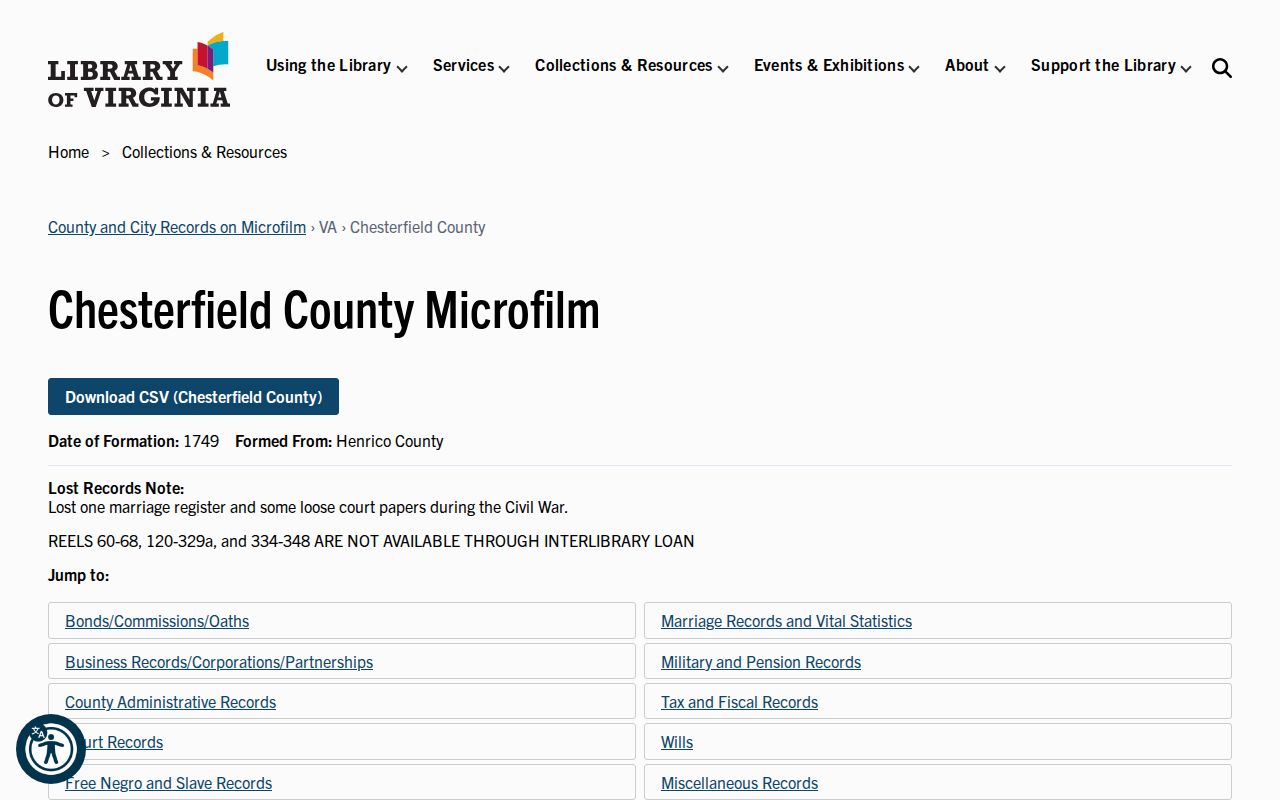
Some LVA reels are unavailable through interlibrary loan, so check the catalog marking before making a request. For the 1913-1966 bridge period, the research did not establish one complete online source; ask the clerk or LVA for the next pre-digital volume.
Meadowbrook Previous Residents in Directory Years
Land records identify recorded parties, but past residents can be found through the household layer. Richmond and Chesterfield reverse directories provide a dated street-address method from 1879-80 onward when the selected volume reaches the area. Search by street and numbered address, then record the exact form printed. A person listed there may be an occupant rather than the owner shown in the deed chain.
Pair a directory issue with the nearest census source and then test the names against deeds, tax material, probate, obituaries, or family files. The directory collections, their geographic labels, and the correct way to read an entry are covered in the Meadowbrook city directory collections. A dated newspaper or obituary can explain a disappearance, but it should not be used to infer a later address without another record.
Household flow: directory year and street entry → census household context → probate, obituary, or family-file lead → deed or tax record for a separate ownership check.
Meadowbrook Address Records Have Different Roles
Do not merge every name connected to a Meadowbrook address into one claim. A deed gives a recorded transaction party. A directory gives a printed household or business listing for a dated issue. A tax record gives land context. A permit can mark work or filing activity. The county's public permit series begins in February 2021, and permit fields can vary, so an application or permit date does not establish who occupied the address.
GIS and READ also separate map context from household facts. A parcel view can show subdivision, adjacent lot geometry, school, and political layers. The current assessment result can display a recorded owner after an address or parcel search. Neither is a complete list of occupants, and the county has not located a public utility hookup database keyed to people. Preserve the source, role, and date rather than filling a gap with an assumption.
Lawful use. Use Meadowbrook address history for family history, estate research, personal records questions, or understanding a property's past. Do not use dated records to stalk, harass, or harm anyone.
Meadowbrook Previous Records and Missing Books
Chesterfield's oldest records have real survival limits. The Library of Virginia reports that one marriage register and some loose court papers were lost during the Civil War. It also describes a preservation problem with Deed Book 1, 1749-1753: earlier cellulose-acetate lamination caused losses, the book was imaged, and conservation work was planned. Those facts explain why a reel, page, or image can be difficult to use. They do not prove a countywide courthouse disaster or a missing transaction.
If a street name does not match a deed, test the legal description, subdivision, lot, older place labels, and nearby intersections. No official Meadowbrook renumbering event was located, so the responsible approach is to test Richmond, Manchester, Chesterfield, and street variants rather than inventing a date. Record the break in the trail, name the next likely book, and ask the clerk or archivist for the proper access channel.
Note: A careful address history preserves uncertainty when a volume, image, or place label cannot be connected to the parcel with dated evidence.